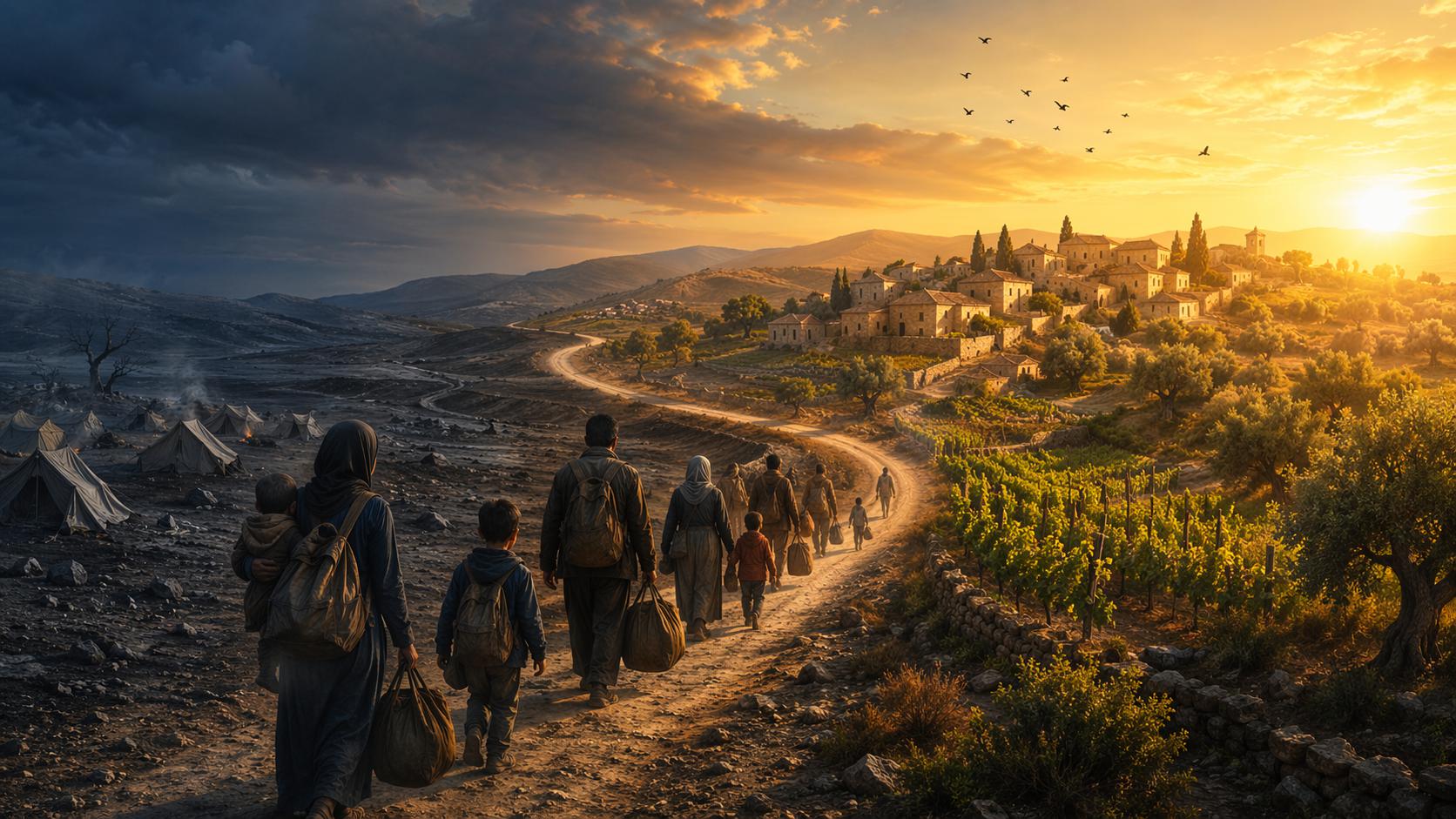
One in every 70 people on earth has been forced to flee their home. As of mid-2025, 117.3 million men, women, and children were forcibly displaced worldwide — driven from everything they knew by persecution, conflict, violence, and human rights violations. Behind that number are real families sleeping in makeshift shelters, real children growing up without a stable address, and real lives suspended indefinitely.
The United Nations High Commissioner for Refugees (UNHCR) calls it one of the highest displacement figures ever recorded. The agency tasked with protecting these people entered 2026 with pledges covering only 18 percent of its projected needs. Resettlement quotas have fallen to their lowest level since 2003. The world's displaced are increasing, while the resources to help them are shrinking.
A Crisis That Keeps Growing
The numbers tell a painful story. Forced displacement has nearly doubled over the past decade. Sudan alone accounts for 14.3 million displaced people, making it the world's largest displacement crisis. Syria, Afghanistan, and Ukraine follow closely behind. Forty percent of all displaced people are children.
The Global Displacement Crisis (2025):
- Total Displaced: 117.3 million people worldwide, including 42.5 million refugees.
- Internal Displacement: 67.8 million people uprooted within their own countries.
- Funding Gap: UNHCR entered 2026 with only 18% of projected needs covered.
- At Risk: 11.6 million displaced people face losing urgently needed assistance due to budget cuts.
Low- and middle-income countries host 73 percent of the world's refugees. Nations that can barely provide for their own citizens are absorbing millions of displaced families, while wealthier nations reduce their contributions. The burden falls hardest on those least equipped to carry it.
Why Human Efforts Cannot Solve This
The UNHCR was established in 1950 as a temporary agency with a three-year mandate to resettle Europeans displaced by the Second World War. Over seven decades later, it is still operating — and the crisis it was created to resolve has multiplied beyond anything its founders imagined.
The problem is not a lack of effort. Dedicated aid workers risk their lives in some of the most dangerous places on earth. Donor conferences are held. Pledges are made. Yet the root causes of displacement — war, injustice, corruption, ethnic hatred, and greed — remain firmly in place. Human governments can relocate refugees, but they cannot remove the forces that created them.
— Ecclesiastes 8:9
Funding depends on political will, and political will shifts with election cycles. In 2025 alone, drastic aid cuts left 11.6 million displaced people at risk of losing basic assistance. Schools for refugee children were forced to close. Families found their reduced aid no longer enough for food, healthcare, or shelter. When budgets tighten, the displaced are among the first to lose support.
Returning Home — But to What?
Even when displaced people manage to return, the path is far from simple. In the first half of 2025, nearly two million refugees and five million internally displaced people went back to their places of origin. On the surface, this sounds hopeful. But the UNHCR itself acknowledges that many of these returns happened under adverse conditions — ongoing insecurity, absent basic services, and no guarantee that displacement will not happen again.
In Afghanistan, large numbers were forced to return to desperate conditions. In Syria, active conflict has eased in some areas, but infrastructure remains shattered. Lasting return requires peacebuilding, social cohesion, and stability — things that human institutions struggle to deliver even in the best of circumstances.
— Romans 3:10, 17
A Government That Builds Permanent Homes
The Bible does not ignore the plight of the displaced. It speaks directly to those who have lost everything and promises something no human agency can deliver — a world where no one will ever be uprooted again.
— Isaiah 65:21, 22
This is not a temporary resettlement program. It is a permanent change in the way the earth is governed. Under God's Kingdom, every person will have a home that is truly their own — not a tent in a camp, not a crowded shelter in a host country, but a place of genuine security and belonging.
What makes this promise different from human pledges? It addresses the root cause. God's Kingdom will not merely manage the consequences of conflict; it will eliminate conflict itself. It will not negotiate between warring parties; it will remove the conditions that produce war — hatred, greed, nationalism, and the lust for power.
— Revelation 21:4
No More Borders, No More Camps
The global refugee system depends on borders. It classifies people as "internally displaced" or "refugees" based on whether they have crossed a national boundary. It assigns responsibility to host countries that may not want them and donor countries that may not fund them. The entire framework is built on division.
God's Kingdom operates on a fundamentally different principle. Under its rule, the earth belongs to all people. There will be no need for asylum applications, no resettlement quotas, and no funding gaps. The Bible describes a world where every family enjoys peace and security in their own place, without fear.
— Micah 4:4
This simple image — a person sitting peacefully under their own vine — captures what 117 million people are longing for today. Not just survival, but stability. Not just shelter, but a home.
Hope That Does Not Depend on Handouts
The UNHCR's work depends on voluntary contributions that can be withdrawn at any moment. Its entire operation is one budget cut away from collapse. God's Kingdom faces no such limitation. Its resources are unlimited, its authority is unchallenged, and its mandate will never expire.
— Psalm 37:11
The displaced people of this world have waited long enough for relief. Human governments have had decades to solve this crisis, and despite genuine effort, the numbers continue to grow. The Bible points to a government that will succeed where every human institution has fallen short — not by managing displacement, but by ending it forever.