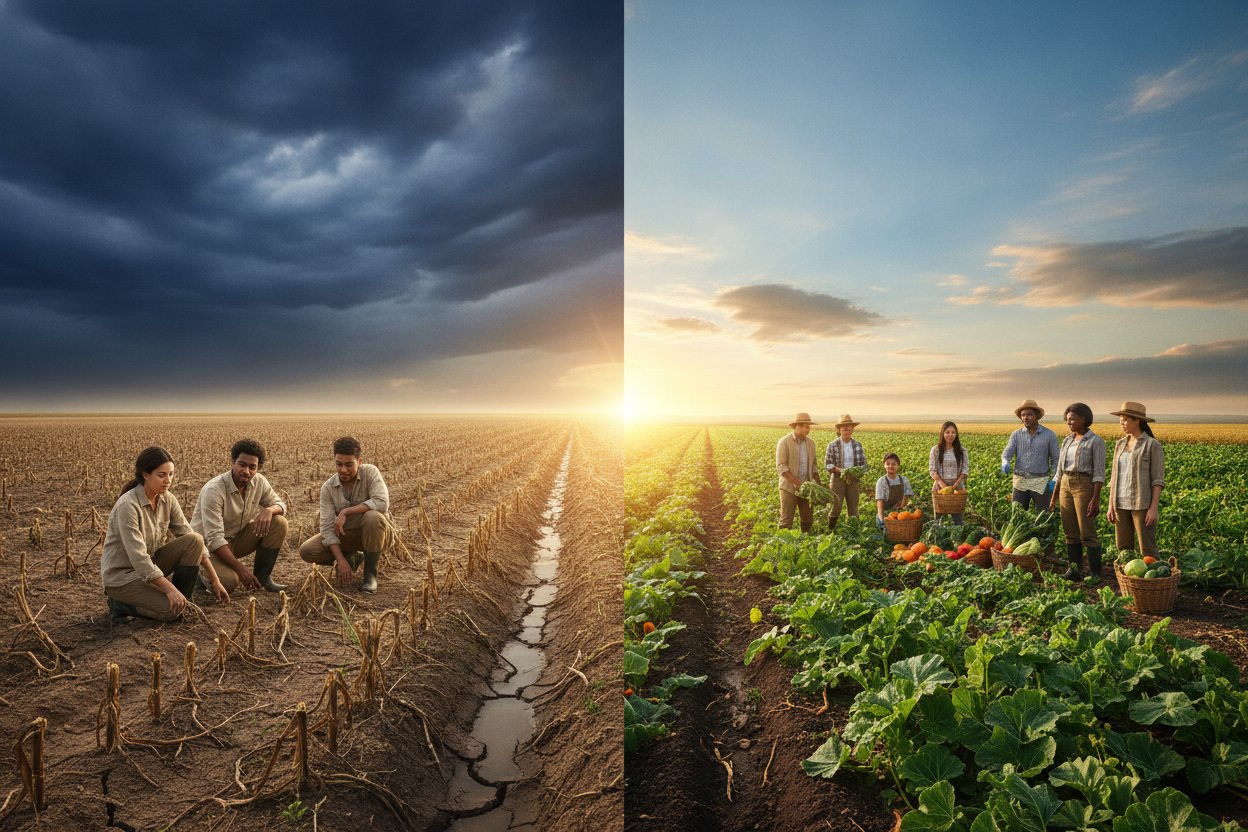
Soil beneath our feet is easy to overlook, yet it supports the crops, grasslands, forests, and water systems on which life depends. In its Global Land Outlook: 2026 Strategic Update, released on October 15, 2026, the United Nations Convention to Combat Desertification warned that 40 percent of the earth’s land is now degraded, directly threatening the well-being of 3.2 billion people (UNCCD, 2026).
The warning is especially serious because productive soil cannot quickly be replaced. The UNCCD reports that the world is losing 100 million hectares of healthy land every year to degradation and desertification (UNCCD, 2026). Summing up the danger, the update states: “We are treating the soil like dirt, yet it is the thin skin of the planet that stands between us and global starvation” (UNCCD, 2026).
The Growing Cost of Soil Degradation (UNCCD, 2026):
- Land already damaged: 40% of the earth’s total land area is classified as degraded, undermining the well-being of 3.2 billion people (UNCCD, 2026).
- Productive land disappearing: The world is losing 100 million hectares of healthy, productive land each year to degradation and desertification (UNCCD, 2026).
- Economic losses: Soil exhaustion and land degradation cause an estimated $6.3 trillion USD in lost ecosystem services every year (UNCCD, 2026).
- A worsening outlook: If current trends continue, an additional 11% of the world’s land, an area about the size of South America, will be degraded by 2050 (UNCCD, 2026).
- Food production at risk: Agricultural yields are projected to fall by 10% globally and by up to 50% in some regions by mid-century because fertile topsoil is being lost (UNCCD, 2026).
Why Human Efforts Fall Short
Soil degradation is driven by problems that often cross borders and generations. Intensive farming can bring short-term gains while exhausting the ground. Expanding cities can cover productive land, and pressure for immediate economic growth can outweigh the need to protect resources that future generations will need. Although farmers, scientists, communities, and international programs are working to restore damaged land, the worldwide losses show that these efforts have not kept pace with the damage.
Genesis 2:15
This principle shows that the earth was not meant to be used carelessly. Soil is a living, complex system, and the UNCCD notes that it can take up to 500 years for just one inch of topsoil to form (UNCCD, 2026). Human governments may recognize the danger, but they must contend with competing interests, changing policies, and economic systems that reward rapid consumption of the land.
A Government That Will Care for the Earth
God’s Kingdom will provide the united and wise administration that the earth needs. Its King, Jesus Christ, will rule with complete concern for people and for the world that sustains them. His government will not sacrifice long-term well-being for temporary advantage or allow hunger to become the price of poor land management.
Psalm 72:16
This promise describes more than emergency relief when crops fail. Under God’s Kingdom, the earth will be managed in a way that provides ample food and benefits everyone. People will be able to enjoy the results of their work without fearing that exhausted soil, drought, or expanding desert will take away their livelihood.
Restored Land and a Secure Future
The prospect of further land loss is unsettling. The UNCCD warns that, if present trends continue, another 11 percent of the world’s land could be degraded by 2050, while crop yields could decline by 10 percent worldwide and by as much as 50 percent in some regions (UNCCD, 2026). Such losses would affect food, livelihoods, and stability for countless families.
Isaiah 35:1
Land-restoration projects and better farming methods can bring meaningful help now. Yet the UNCCD’s findings show that human efforts have not stopped the worldwide decline in soil health (UNCCD, 2026). God’s Kingdom will restore the earth and establish conditions in which people can live securely, with productive land, sufficient food, and confidence that the natural world will be cared for properly.