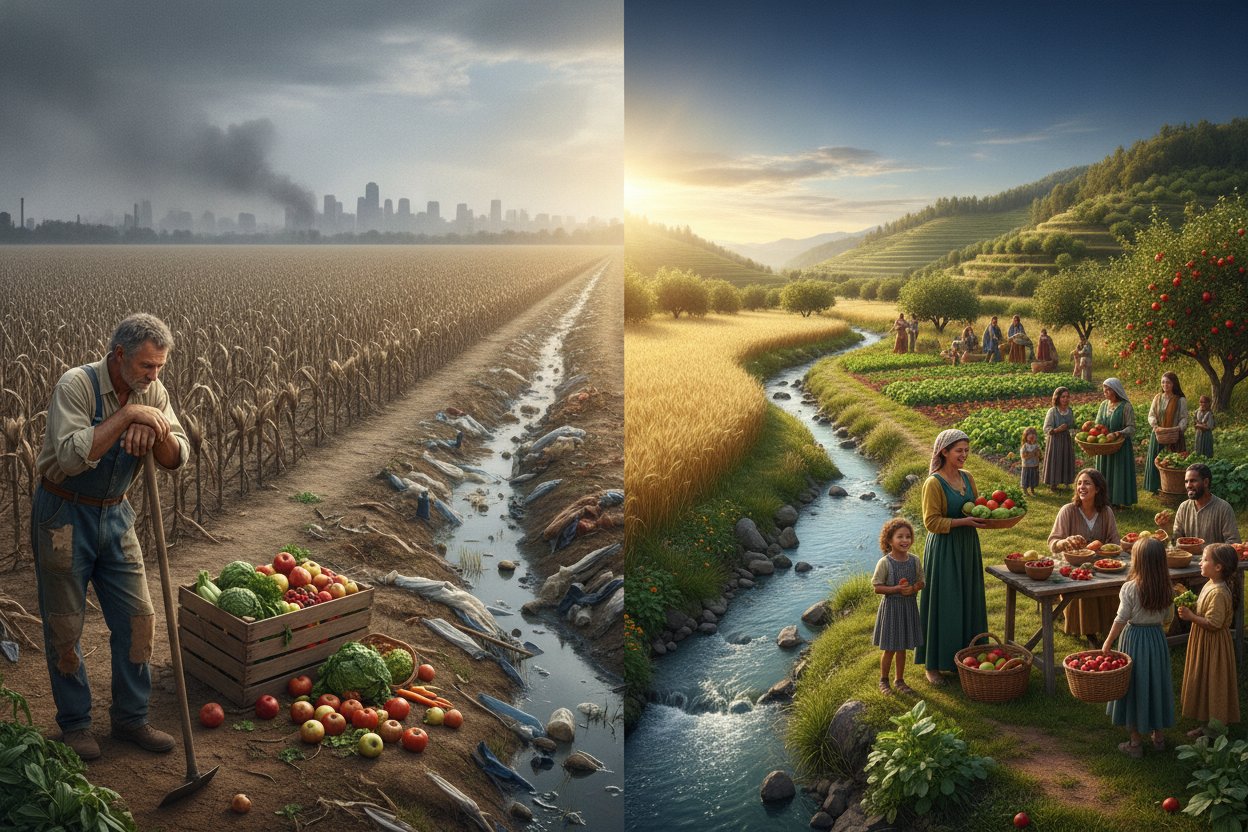
Food production has increased greatly in recent decades, and markets offer more choices than ever before. Still, the way food is produced, processed, sold, and consumed carries costs that often do not appear on a grocery receipt or a national budget. On November 5, 2024, the Food and Agriculture Organization of the United Nations released The State of Food and Agriculture 2024, estimating that global agrifood systems create $12 trillion in hidden costs each year (FAO, 2024).
Much of this burden is borne by people whose diets contribute to serious illness, as well as by communities affected by pollution and environmental damage. The FAO observed: “The way we produce and consume food is taking a heavy toll on our health and our planet.” Although human institutions have succeeded in increasing the volume of food available, they have not ensured that everyone can obtain healthy food produced in a way that protects the earth.
The Hidden Cost of Today’s Food Systems:
- A $12 trillion annual burden: The hidden costs of global agrifood systems are estimated at $12 trillion each year, or about 10% of global GDP (FAO, 2024).
- Diet-related illness is the largest cost: Non-communicable diseases linked to poor diets account for 70% of hidden costs, totaling $8.4 trillion annually (FAO, 2024).
- Poorer countries carry a heavier load: In low-income countries, food-system hidden costs average 27% of national GDP (FAO, 2024).
- Damage to the environment: Environmental costs, including greenhouse-gas emissions and nitrogen runoff, add about $2 trillion to the annual total (FAO, 2024).
- Healthy diets remain out of reach: Current food systems are failing to provide healthy diets for more than 3 billion people worldwide (FAO, 2024).
Why Food Can Carry Such a Heavy Cost
Food systems involve farmers, workers, businesses, consumers, governments, and international markets. Each can make useful contributions, but the costs of poor nutrition and environmental harm are often passed on to others. A food item may appear inexpensive at the point of purchase while the longer-term consequences are felt by families facing illness, communities dealing with pollution, and public services bearing added pressure.
Proverbs 11:1
This proverb expresses God’s concern for fairness and honesty in human dealings. The FAO found that health-related costs connected with poor diets account for 70% of the global hidden total, or $8.4 trillion each year (FAO, 2024). Governments and organizations can promote healthier choices and reduce pollution, but they must work within competing economic interests, unequal resources, and changing political priorities. These limits make it difficult for human systems to correct every injustice built into the present arrangement.
A Government That Provides With Justice
God’s Kingdom will provide the united and just government that people need. Jesus Christ, its King, will rule with wisdom, compassion, and complete concern for every person. His administration will not allow the needs of the poor, the health of families, or the care of the earth to be treated as hidden costs.
Psalm 72:16
This promise describes a world of genuine abundance. Under God’s Kingdom, food will not be a source of preventable illness, financial hardship, or environmental damage. People everywhere will benefit from a secure and productive earth, and no community will be overlooked because it lacks wealth, influence, or access to markets.
Hope for Wholesome Food for Everyone
The present problem affects countries differently. In low-income countries, hidden food-system costs equal an average of 27% of national GDP, while environmental damage contributes about $2 trillion to the global annual total (FAO, 2024). At the same time, more than 3 billion people are not being provided with healthy diets by current food systems (FAO, 2024). These figures show that producing large amounts of food has not solved the deeper problem of providing nourishing food fairly and sustainably.
Psalm 85:12
Farmers, health workers, researchers, and communities who promote healthy food and protect the environment deserve appreciation. Yet the FAO’s $12 trillion estimate shows how far human institutions remain from a food system that truly benefits everyone (FAO, 2024). God’s Kingdom will bring the conditions in which all people can enjoy wholesome nourishment, the earth can be cared for properly, and food will contribute to health, peace, and lasting security.