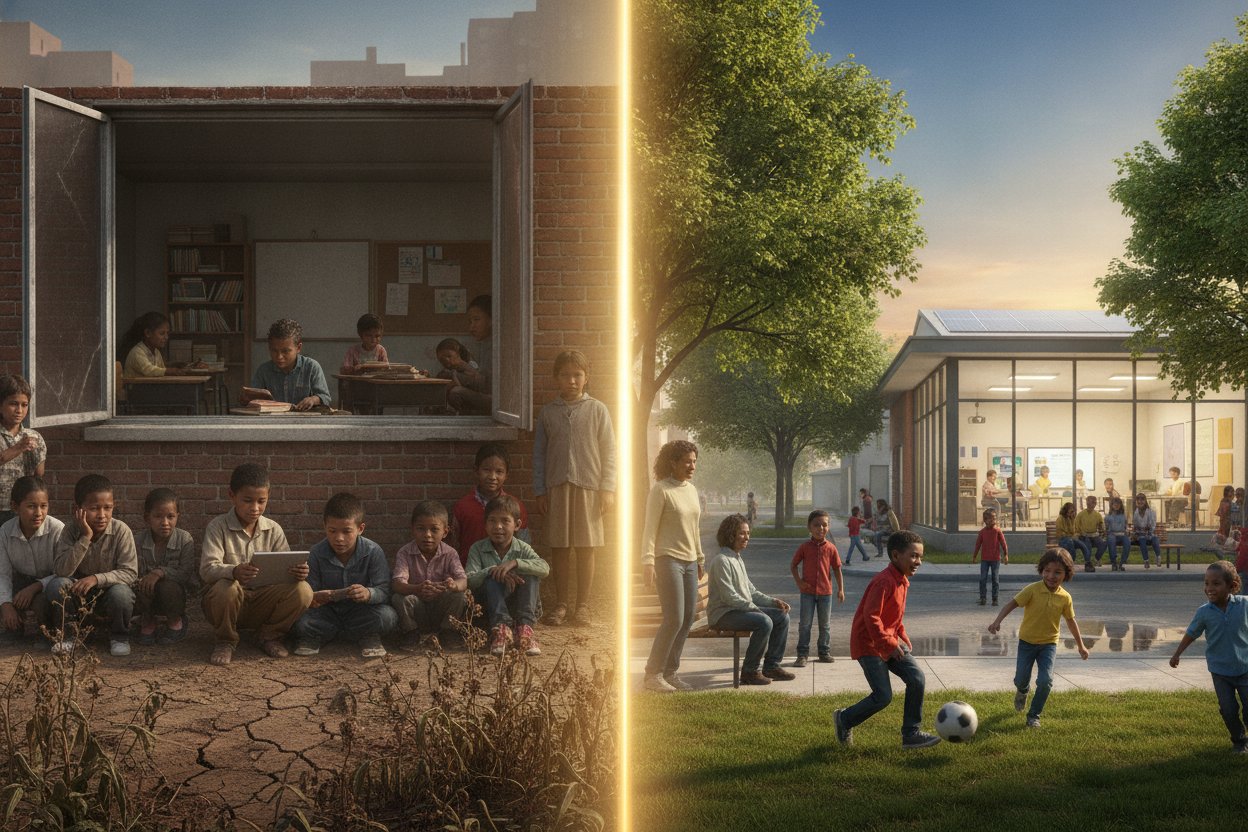
Childhood should be a time of safety, learning, and hope. Yet a major UNICEF report released on November 13, 2024, warned that the future of an entire generation could be shaped by three powerful trends: demographic shifts, climate crises, and frontier technologies (UNICEF, 2024).
The report explains that where a child is born may increasingly determine whether that child has access to water, education, protection from dangerous heat, and digital learning opportunities. UNICEF observed: “The future of childhood is at a crossroads. Decisions made today will determine whether the children of 2050 inherit a world of opportunity or a world of deepening crisis” (UNICEF, 2024).
The Future of Childhood at Risk (UNICEF, 2024):
- Extreme heat will affect far more children: By 2050, the number of children exposed to extreme heatwaves is projected to increase eightfold compared with the 2000s (UNICEF, 2024).
- Many children will live where resources are limited: Nearly 50% of the world’s children will reside in sub-Saharan Africa and South Asia by 2050, regions with the least resources to support them (UNICEF, 2024).
- Water shortages will threaten children’s well-being: One in four children will live in areas with high or very high water scarcity by mid-century (UNICEF, 2024).
- The digital learning gap remains severe: Only 26% of people in low-income countries have internet access, compared with more than 95% in high-income nations (UNICEF, 2024).
- Child populations are shifting toward poorer countries: By 2050, the child population in the world’s poorest countries will rise to 38%, while shrinking to just 10% in wealthy nations (UNICEF, 2024).
Why Children Are Left Unequally Protected
Governments, aid agencies, educators, and local communities work hard to improve children’s lives. They can provide schools, health services, clean-water projects, and emergency help. Still, the challenges described by UNICEF are developing across national borders and at different speeds. Communities already facing limited resources may have to support growing child populations while also coping with heat, water shortages, and changing technology (UNICEF, 2024).
Psalm 82:3
This verse reflects God’s concern for those who have little power to protect themselves. Children depend on adults, institutions, and communities to provide what they need. Yet access to important opportunities remains deeply unequal. Only 26% of people in low-income countries have internet access, compared with more than 95% in high-income nations, leaving many children at a disadvantage in a world where learning and opportunity increasingly depend on connectivity (UNICEF, 2024). Human institutions can offer valuable assistance, but they have not been able to ensure that every child receives equal protection and a secure start in life.
A Kingdom That Will Protect Every Child
God’s Kingdom will provide the just and compassionate rule that human governments have not been able to establish fully. Its King, Jesus Christ, showed special warmth toward children and concern for people who were vulnerable. His rulership will never be restricted by national boundaries, shortages of resources, or unequal access to essential services.
Isaiah 32:17-18
This promise describes security that is lasting, not dependent on a family’s location or wealth. Under God’s Kingdom, no child will be overlooked because of geography, poverty, or a lack of technology. God’s government will care for the earth and its people in a way that allows families to live safely, with the resources needed to raise their children in peace.
A Future Where Children Can Flourish
UNICEF’s projections show why lasting solutions are needed. By 2050, children’s exposure to extreme heatwaves is projected to be eight times higher than in the 2000s, and one in four children will live in areas facing high or very high water scarcity by mid-century (UNICEF, 2024). At the same time, nearly 50% of the world’s children will live in sub-Saharan Africa and South Asia, where available resources are least able to meet growing needs (UNICEF, 2024).
Zechariah 8:5
This peaceful picture gives a reason for hope. Those who care for children, provide education, and work to relieve hardship deserve appreciation, and their efforts can bring real help now. But the growing pressures on childhood show that human systems cannot guarantee a safe and hopeful future for every child. God’s Kingdom offers the sure hope of a world where children can learn, play, grow strong, and enjoy true peace and security.