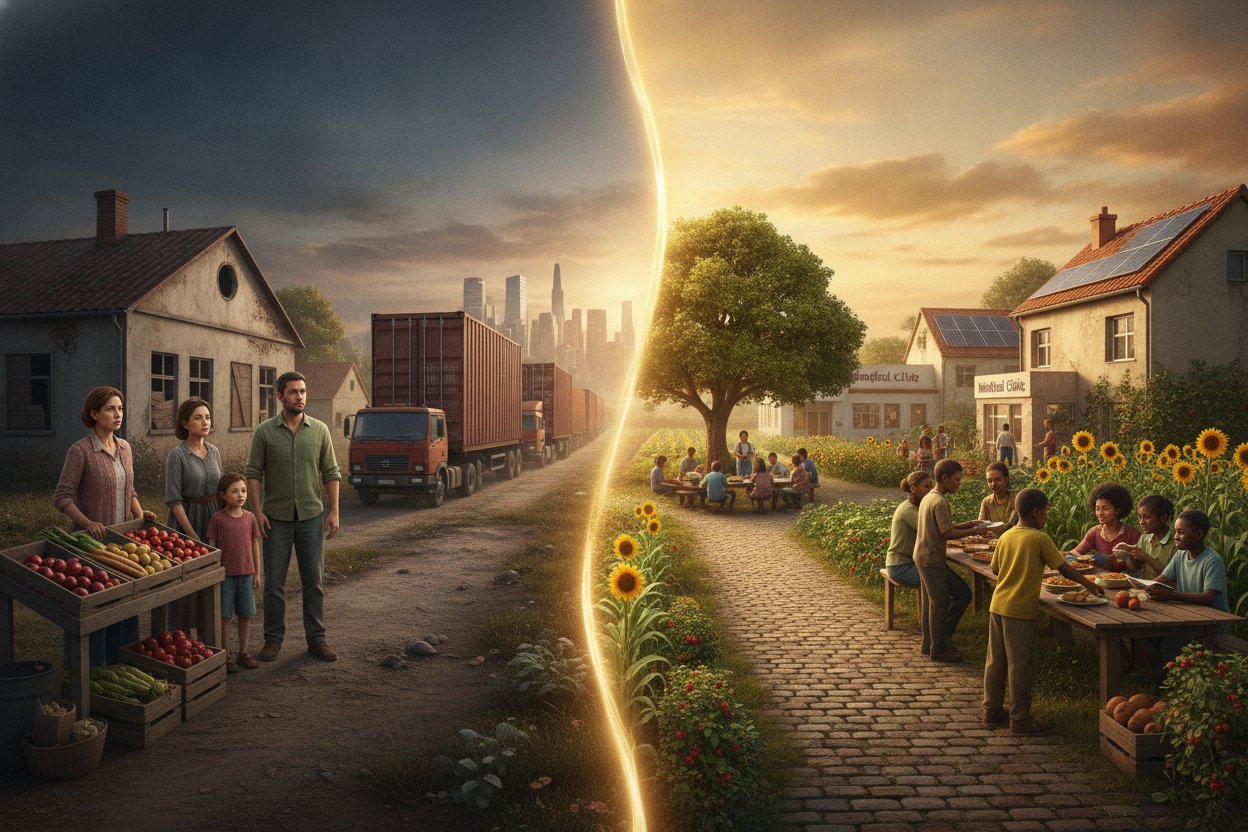
People work hard to provide food, housing, education, and a secure future for their families. Yet in many poorer nations, the resources produced by people’s labor do not remain where they are most needed. On October 14, 2026, the World Inequality Lab released the World Inequality Report 2026, reporting that approximately 1% of global GDP flows from poorer to richer nations each year through net foreign income transfers (World Inequality Lab, 2026).
The report describes a financial arrangement in which wealthy economies benefit from what it calls an “exorbitant privilege,” including higher returns on their overseas assets and lower interest payments on their liabilities. It warns that reversing this pattern is central to any credible strategy for global equity (World Inequality Lab, 2026). Although humanitarian aid and development programs can bring needed relief, a system that continually draws wealth away from poorer countries makes lasting progress difficult.
Global Inequality and Financial Transfers:
- Wealth flows toward richer nations: Approximately 1% of global GDP moves annually from poorer to richer nations through net foreign income transfers (World Inequality Lab, 2026).
- The transfer exceeds development aid: The annual flow of wealth from poor to rich nations is roughly three times the total amount of global development aid (World Inequality Lab, 2026).
- Extreme poverty remains widespread: An estimated 826 million people worldwide are living in extreme poverty in 2026 (World Bank, 2026).
- Systemic inequality affects many people: One in five people globally lives in an economy characterized by high levels of systemic inequality (World Bank, 2026).
- Progress against extreme poverty has stalled: Global extreme poverty is projected to decline only marginally to 9.8% by the end of 2026, with progress stalled since 2019 (World Bank, 2026).
Why Human Economic Systems Fall Short
Economists, aid workers, community organizations, and many government officials sincerely seek to reduce poverty and widen opportunity. Their work can provide vital support during emergencies and help families build better lives. Still, the present financial structure places poorer nations at a persistent disadvantage. When income from investments and debt payments repeatedly moves toward already wealthy economies, countries with fewer resources can struggle to fund hospitals, schools, infrastructure, and other essential services.
Proverbs 22:7
This proverb recognizes that debt can create an unequal relationship. The issue facing poorer nations is larger than any one loan or financial decision. The World Inequality Report 2026 shows that the overall system produces a continuing transfer equal to approximately 1% of global GDP each year, from poorer nations to richer ones (World Inequality Lab, 2026). Human institutions may try to soften the effects, but they have not removed the arrangements that allow prosperity to be concentrated while hundreds of millions remain in extreme poverty.
A Kingdom That Will Establish Justice
God’s Kingdom will provide the fair and compassionate rule that human governments and financial institutions have never been able to achieve completely. Jesus Christ, its King, will not favor wealthy nations, powerful investors, or those able to influence policy. His rulership will ensure that every person is treated with dignity and can benefit from the earth’s resources.
Isaiah 32:17
This promise connects justice with genuine security. Under God’s Kingdom, peace will not depend on unstable markets, unequal access to credit, or financial structures that reward one group at another’s expense. God will remove exploitation and establish conditions in which people can use their abilities productively and enjoy the results of their work.
Hope for a Secure Future
The contrast between wealth transfers and human need is striking. The annual transfer from poorer to richer nations is roughly three times total global development aid, while 826 million people are living in extreme poverty worldwide in 2026 (World Inequality Lab, 2026; World Bank, 2026). With global extreme poverty projected to decline only marginally to 9.8% by the end of 2026, it is clear that temporary assistance alone cannot correct the deeper problem (World Bank, 2026).
Isaiah 11:4
This prophecy assures us that Christ will judge with complete fairness. Those who work to relieve poverty, provide aid, and promote economic justice deserve appreciation for their compassionate efforts today. Yet the world’s continuing inequality shows that human systems cannot guarantee a fair foundation for every nation and family. God’s Kingdom offers the sure hope of a world where no one is trapped by poverty, exploited for another’s gain, or denied the security that justice can bring.